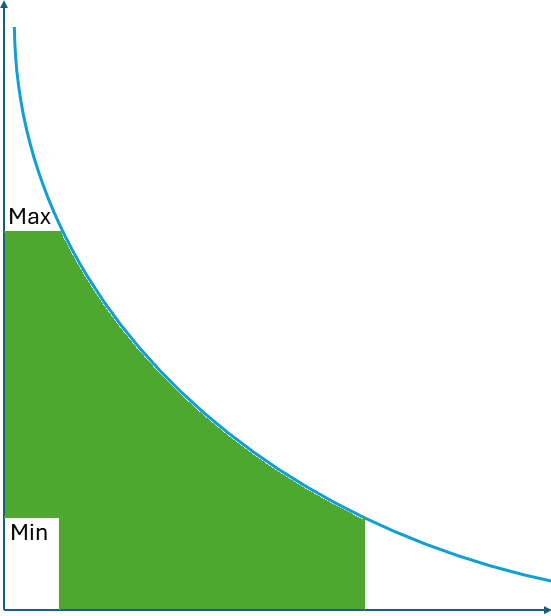
Free Chlorine (FC) is the amount of chlorine available to sanitize the water. If your FC drops below Min, bacteria can grow. The predicted value is based on the chlorine consumption between tests (Chlorine Demand) plus any bleach or dichlor added. Hot tub usage may drastically affect FC. The predicted value allows you to test less often, but do not trust it. When in doubt, test the FC to be sure.
FC
CYA
FC below Min
Add the chemicals recommended below to correct any test values that are outside the ideal range and to reach the Target FC (Max by default). Be sure to adjust the Strength of each chemical to match the Active Ingredient % on your bottles.
Sodium Dichloro-s-Triazinetrione Dihydrate (Dichlor) is a granular chlorine that also contains Cyanuric Acid (CYA).
Sodium Hypochlorite (Bleach) is a liquid chlorine that does not contain Cyanuric Acid (CYA). Sodium Hypochlorite labeled for pools/spas is recommended but you can also use household "Bleach". If you use "Bleach", be sure it contains no softeners, is not color-fast, and is unscented. Pay attention to the label strength.
Sodium Bisulfate (pH/TA Down) is a granular dry acid that lowers pH and Total Alkalinity (TA). Alternatively, you can use liquid Muriatic Acid which has the advantage of not creating sulfates, which irritate some people`s skin. I recommend the lower strength Muriatic Acid (~14.5 %) because it is very powerful. Follow all handling precautions!
Sodium Bicarbonate (commonly known as Baking Soda or Sodium Hydrogen Carbonate) is used to raise Total Alkalinity (TA), but will also have some effect on pH.
Sodium Carbonate (Soda Ash) is used to raise pH, but will also have some effect on Total Alkalinity (TA).
Calcium Chloride is used to raise Calcium Hardness (CH).
Ahh-some 3-in-1 Weekly Maintenance should be added once per week to destroy biofilms and other contaminants that may be resistant to chlorine. Follow the manufacturer's instructions for proper dosage and application.
Use a Taylor K-2006 or similar test kit. Test strips are less accurate and are not recommended.
Free Chlorine (FC) is the amount of chlorine available to sanitize the water. If your FC drops below Min, bacteria can grow.
Combined Chlorine (CC) represents the chlorine that is used up and already combined with contaminants in the water. CC is what can cause skin and eye irritation. If CC rises above 0.5 ppm, you should add bleach or dichlor more often to keep FC closer to the Max level more regularly which will destroy CC.
pH is a measure of how acidic or basic the water is. If pH is too low, it can cause skin irritation and corrode metal parts. If pH is too high, it can cause scale buildup and cloudy water.
If pH is too high, use the Acid Demand (AD) test to determine how much acid is needed to lower the pH to the ideal range.
If pH is too low, use the Base Demand (BD) test to determine how much base is needed to raise the pH to the ideal range.
Cyanuric Acid (CYA) stabilizes the chlorine. If your CYA is too low, you will have trouble maintaining the required FC level (the chlorine will be quickly destroyed). If CYA is too high, your chlorine will become ineffective at killing bacteria. Dichlor contains CYA but Bleach does not. This app will automatically suggest Bleach or Dichlor to maintain your CYA in the recommended range.
Total Alkalinity (TA) represents the ability of the water to resist acidification. If TA is too high, the pH will drift up. If TA is too low, the pH will drift down. You should adjust TA first, wait two hours, then test and adjust pH. If pH consistently drifts up (or down) over several weeks, consider testing and adjusting TA. Otherwise, focus solely on pH. If pH has been stable in the ideal range, but your TA tests high or low, edit your Target TA to match your current (Corrected) Test Value. Corrected TA has been adjusted to compensate for false-high readings due to CYA level.
Calcium Hardness (CH) represents the amount of calcium in the water. If CH is too low, it can cause corrosion of metal parts. If CH is too high, it can cause scale buildup and cloudy water.
The number of gallons in your hot tub is very important for the calculations made by this app. If you enter the wrong number, the recommended amounts of each chemical to add will be wrong! You need to top off your water level periodically due to evaporation.
Be sure to take out and spray off your filter with a garden hose every few weeks or as needed. Approximately once per year, replace your filter with a brand new one.
Show all Chemicals and Tests ✎Edit Target FC
Active Ingredient %Enter value from chemical bottle.
Target FCEnter new target free chlorine.
Target TAEnter new target total alkalinity.
Target CHEnter new target calcium hardness.